

Can You Claim Rent or Travel When Working from Home? What the 2026 Hall Case Means for Your Tax Return


2026 Small Business Tax Changes (Part 1):New $20,000 Write-Off
|
|
August 23, 2026 |
For over a decade, Australian business owners have been caught in a frustrating tax cycle, waiting on each Federal Budget to find out whether important tax concessions would survive for another year. The instant asset write-off is a perfect example. What was originally intended to encourage business investment became a moving target, with constantly changing thresholds. For business owners trying to plan equipment purchases or long-term growth, tax planning was rarely straightforward.
That uncertainty officially ends in 2026.
With the passage of the Treasury Laws Amendment (Tax Reform No. 1) Act 2026 and the introduction of the Treasury Laws Amendment (Tax Reform No. 2) Bill 2026, Australia’s small and medium business tax framework is undergoing some significant changes.
At the centre of these reforms are three key measures every business owner should understand:
- Permanent $20,000 Instant Asset Write-Off – Giving eligible small businesses greater certainty when purchasing business assets.
- Expanded Small Business CGT Relief – Increasing the turnover threshold from $2 million to $10 million for the 50% active asset reduction, potentially giving more businesses access to valuable CGT relief when selling or restructuring.
- Permanent Corporate Loss Carry-Back Rules – Allowing eligible companies to carry tax losses back against previously taxed profits and potentially receive a refund of company tax already paid.
While media headlines have focused heavily on the changes to negative gearing and CGT for property investors, these business-focused reforms could have a significant impact on SME cash flow and long-term tax planning.
In this two-part article, we break down how these rules work, their practical impact on your business, and the key tax planning opportunities to consider for the 2026–27 financial year and beyond.

Permanent $20,000 Instant Asset Write-Off
For years, small business owners have had to wait for each Federal Budget to find out whether the $20,000 Instant Asset Write-Off would continue or fall back to a much lower threshold.
Under the 2026 reforms, the $20,000 threshold becomes permanent, giving small businesses much-needed certainty when planning equipment and asset purchases.
In simple terms, an eligible small business can immediately claim the business-use portion of an eligible asset costing less than $20,000, rather than depreciating the cost over several years.
Who Can Use the $20,000 Write-Off?
The main rules are relatively straightforward:
- Turnover: Your business must have aggregated annual turnover of less than $10 million.
- The limit applies per asset: The $20,000 threshold is not an annual cap. You can potentially claim multiple assets costing less than $20,000 each.
- The asset must be ready to use: It must be first used, or installed ready for use, during the relevant financial year.
- Business use matters: If an asset is partly used privately, you can only claim the business-use portion.
Example: Buying Multiple Assets
Assume a small construction business purchases:
- Laptop computers – $8,000
- New tools – $12,000
- Office equipment – $6,000
Although the business has spent $26,000 in total, each asset costs less than $20,000.
Provided the other eligibility requirements are satisfied, the business may be able to claim the full $26,000 as an immediate tax deduction rather than depreciating those assets over several years.
This is an important point: the $20,000 limit applies to each asset, not to your total purchases for the year.
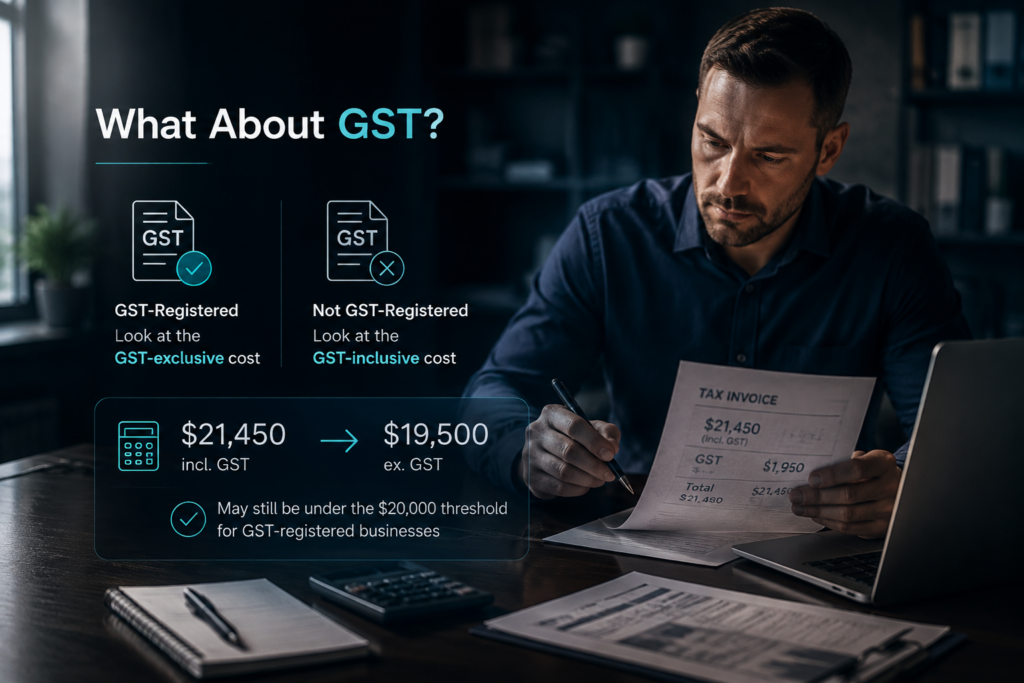
What About GST?
If your business is registered for GST and entitled to claim the GST credit, the $20,000 threshold generally looks at the GST-exclusive cost of the asset.
If your business is not registered for GST, the GST-inclusive cost is generally relevant.
For example, an asset purchased for $21,450 including GST has a GST-exclusive cost of $19,500. A GST-registered business that can claim the full GST credit may therefore still fall below the $20,000 threshold.
What If the Asset Costs $20,000 or More?
An asset costing $20,000 or more does not qualify for the immediate write-off.
Instead, eligible businesses using the simplified depreciation rules generally add the asset to their small business depreciation pool.
The deduction is generally:
- 15% in the first year, regardless of when during the year the asset was purchased; and
- 30% of the remaining pool balance each year after that.
There is another useful rule. If the balance of your small business depreciation pool falls below $20,000 at the end of the financial year, the remaining balance may be able to be written off completely.
The Five-Year Lock-Out Rule
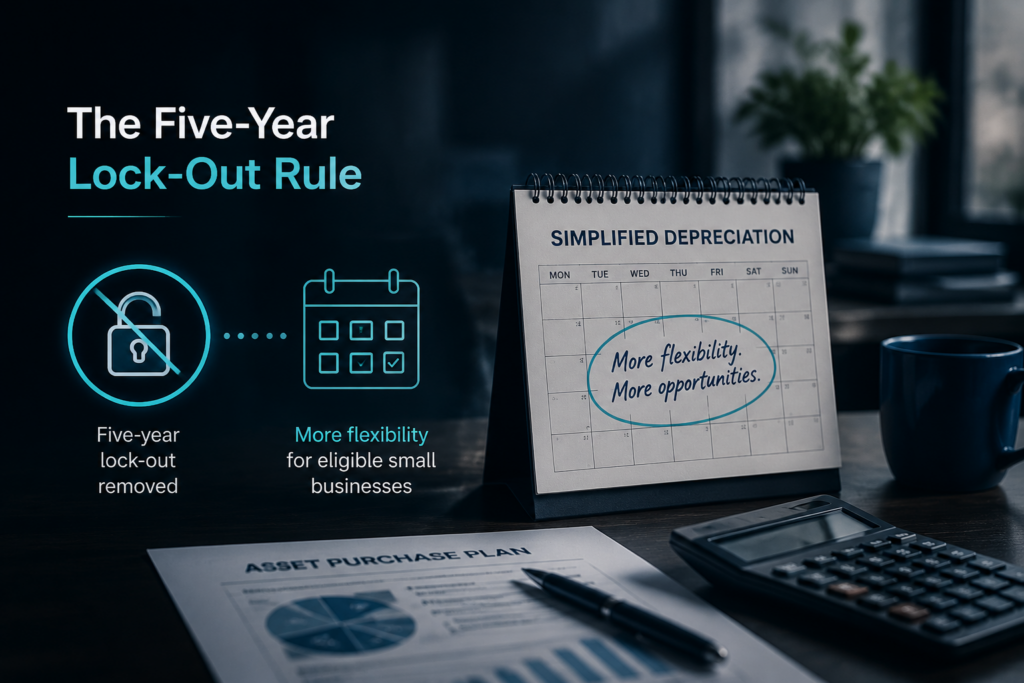
Another useful change involves the old five-year lock-out rule.
Previously, a small business that chose to stop using the simplified depreciation rules could be prevented from using them again for five years.
Under the new rules, this restriction is suspended, giving eligible small businesses greater flexibility to use the simplified depreciation system and access the $20,000 Instant Asset Write-Off.
Don’t Spend $20,000 Just to Save Tax
This is probably the most important point for business owners.
A $20,000 tax deduction does not mean you receive $20,000 back from the ATO.
For example, if a company purchases an eligible business asset for $18,000 and is paying tax at 25%, an $18,000 deduction could reduce its tax by approximately $4,500, assuming it has sufficient taxable income.
The business has still spent $18,000.
The permanent write-off therefore shouldn’t be a reason to buy something your business doesn’t need. Its real benefit is that if you were already planning to purchase an eligible asset, you may be able to claim the deduction immediately rather than waiting several years through depreciation.

Tax Planning Opportunity
With the $20,000 threshold becoming permanent, there should be less reason for the traditional 30 June rush to buy equipment purely for tax purposes.
Instead, business owners can plan purchases around when the business actually needs them.
Before making a significant purchase, consider:
- whether the asset will cost less than $20,000;
- whether it will be ready for use before the end of the financial year;
- whether there is any private use; and
- whether your existing depreciation pool is approaching the $20,000 write-off threshold.
There is also another important planning opportunity for companies. If immediate asset deductions help push a profitable company into a tax loss, that loss may potentially interact with the new loss carry-back rules. We will look at this in our “2026 Small Business Tax Reforms (Part 2): $10M Active Asset CGT Relief & Permanent Loss Carry-Back Refunds” article.
Conclusion & Next Steps
The permanent $20,000 Instant Asset Write-Off provides long-overdue certainty for Australian small businesses. By ending the year-by-year legislative extensions and suspending the 5-year lock-out rule, business owners can finally time equipment investments around actual operational demand rather than arbitrary tax deadlines.
However, immediate write-offs are only one part of the 2026 tax reform package.
Coming Up in Part 2: We examine the major structural changes affecting company directors and business owners planning an exit—including the expansion of the $10M Small Business CGT threshold under Section 152-C and how to claim cash tax refunds through the permanent Corporate Loss Carry-Back framework under Division 160.
Need help optimizing your asset register or timing capital purchases? Book a Strategic Tax Consultation (STC) with our team to ensure your business claims every dollar of eligible deductions while remaining compliant.
Reference

Book a Tax Strategic Consultation with Investax to understand how the right tax structure, planning, and long-term strategy can help you minimise tax, protect your assets, and make smarter financial decisions before costly mistakes are made. Whether you are investing in property, growing a business, or planning your next financial move, getting advice upfront can make a significant difference.
Book Your Strategic Consultation
Frequently Asked Questions (FAQs) – Part 1
1. Is the $20,000 Instant Asset Write-Off GST-inclusive or GST-exclusive?
It depends on whether your business is registered for GST.
If your business is registered for GST and entitled to claim the GST credit, the $20,000 threshold generally applies to the GST-exclusive cost of the asset.
If your business is not registered for GST, the GST-inclusive cost is generally used.
2. Can I claim the $20,000 Instant Asset Write-Off on more than one asset?
Yes. The $20,000 threshold applies to each individual asset, not to your total purchases for the financial year.
For example, an eligible business could purchase three separate assets costing $8,000, $12,000 and $15,000 and potentially claim an immediate deduction for each one, provided all the other requirements are met.
3. What happens if an asset costs $20,000 or more?
You generally cannot claim an immediate deduction under the $20,000 write-off.
Instead, eligible businesses using simplified depreciation generally add the asset to their small business depreciation pool, where it is deducted at 15% in the first year and 30% in later years.
4. What happens if my depreciation pool falls below $20,000?
If your small business depreciation pool balance falls below $20,000 at the end of the financial year, you may be able to write off the remaining pool balance in full.
5. What is the five-year lock-out rule?
Normally, if a small business chooses to stop using the simplified depreciation rules, it can be prevented from using them again for five years.
However, the Government has extended the temporary suspension of this lock-out rule until 30 June 2027. This means an otherwise eligible small business can choose to use simplified depreciation during this period without being prevented by the normal five-year restriction.
6. Does a $20,000 write-off mean I get $20,000 back in tax?
No. The instant asset write-off is a tax deduction, not a $20,000 tax refund.
For example, if a company purchases an eligible $20,000 asset and its applicable company tax rate is 25%, a $20,000 deduction could reduce its tax by up to $5,000, assuming it has sufficient taxable income and the asset is used entirely for business purposes.
This is why you should not purchase an asset simply to get a tax deduction. The write-off is most valuable when your business already needs the asset and can bring forward the tax deduction instead of depreciating the cost over several years.
General Advice Warning
The material on this page and on this website has been prepared for general information purposes only and not as specific advice to any particular person. Any advice contained on this page and on this website is General Advice and does not take into account any person’s particular investment objectives, financial situation and particular needs.
Before making an investment decision based on this advice you should consider, with or without the assistance of a securities adviser, whether it is appropriate to your particular investment needs, objectives and financial circumstances. In addition, the examples provided on this page and on this website are for illustrative purposes only.
Although every effort has been made to verify the accuracy of the information contained on this page and on our website, Investax Group, its officers, representatives, employees and agents disclaim all liability [except for any liability which by law cannot be excluded), for any error, inaccuracy in, or omission from the information contained in this website or any loss or damage suffered by any person directly or indirectly through relying on this information.