

Personal Services Income (PSI): Does Your Business Structure Pass the ATO Tests?


30% Minimum Tax on Family Trusts: What Australian Families and Business Owners Need to Know – Updated November 2026
|
|
November 25, 2026 |
Family trusts have long been an important part of Australian tax and wealth planning. They are commonly used by families to operate businesses, hold investment properties, manage investments, protect family assets and plan for succession. However, proposed changes to Australia’s trust taxation rules could significantly affect how discretionary trusts distribute income and manage their tax liabilities.
The Federal Government’s proposed 30% minimum tax on discretionary trusts, announced in the 2026–27 Federal Budget, is intended to take effect from 1 July 2028.
The legislation has now passed the House of Representatives and progressed to the Senate. Although this is an important development, the proposed changes are not yet law.
For families with existing discretionary trusts, business owners and property investors, now is a good time to review their structures and understand the potential tax implications before the proposed commencement date.
What Is the Proposed 30% Minimum Tax on Family Trusts?
Under the proposed legislation, certain discretionary trusts will be subject to a minimum tax rate of 30% on their net income, excluding specified categories of income.
Unlike the current arrangements, where discretionary trustees can generally distribute taxable income among eligible beneficiaries according to the trust deed, the proposed changes introduce a minimum tax liability at the trustee level.
Where the trustee pays the minimum tax, eligible individual beneficiaries will generally receive a non-refundable tax offset for the tax paid on their share of the trust income. This means beneficiaries will not necessarily receive a refund if their personal marginal tax rate is below 30%.
For example, a beneficiary who would ordinarily pay tax at a marginal rate below 30% may be worse off under the proposed arrangements because the unused portion of the tax offset cannot be refunded. The changes are intended to limit the tax benefits of distributing trust income to family members on lower marginal tax rates.
When Will the 30% Trust Tax Start?
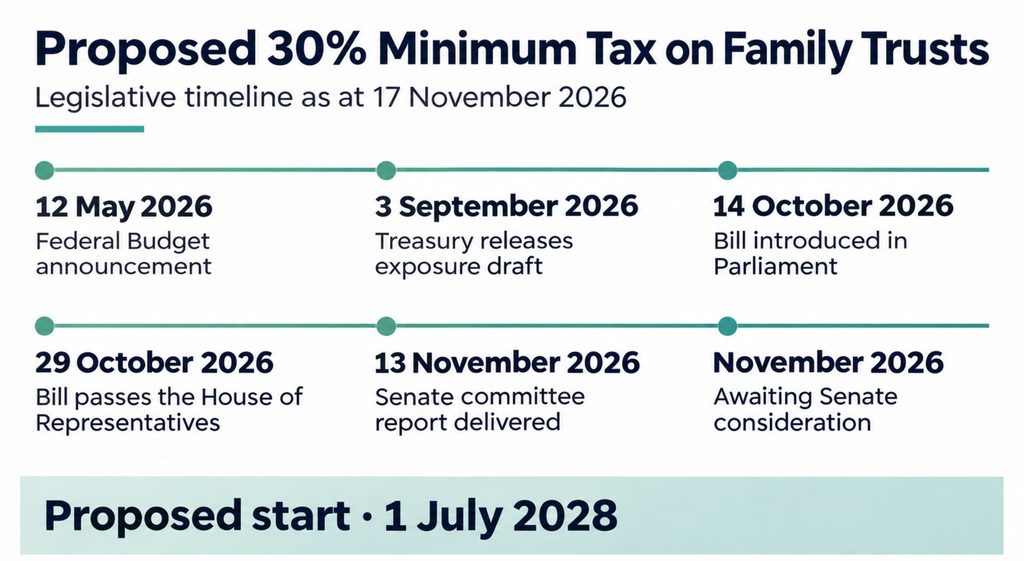
The proposed minimum tax is intended to apply from 1 July 2028, covering income years beginning on or after that date.
The legislative timeline is important:
- 12 May 2026: Government announces the proposed minimum tax in the Federal Budget.
- 3 September 2026: Treasury releases exposure draft legislation.
- 14 October 2026: Legislation introduced into Federal Parliament.
- 29 October 2026: The legislation passes the House of Representatives.
- 13 November 2026: Senate committee inquiry report due and delivered.
- November 2026: The legislation remains subject to Senate consideration.
The ATO confirmed in its 3 November 2026 update that the measure is not yet law.
Families should therefore avoid making significant structural changes based solely on proposed legislation. However, early planning is important given the potential financial and commercial implications.
Which Family Trusts Will Be Affected?
The proposed minimum tax is primarily directed at discretionary trusts, including many family trusts used by Australian business owners and property investors. However, not every trust or every category of trust income will be affected.
The proposed exclusions include:
- Fixed trusts that satisfy the relevant requirements.
- Special disability trusts.
- Complying superannuation entities.
- Certain deceased estates and qualifying testamentary trust income.
- Certain primary production income.
- Specific income relating to vulnerable minors.
- Qualifying distributions to charities and other eligible tax-exempt entities.
Importantly, the classification of a trust depends on its legal structure, trust deed and the nature of its income. Families should not assume that their trust is automatically excluded simply because it holds business or investment assets.

What Are the Options for Existing Family Trusts?
For families with an existing discretionary trust, there are four broad options worth considering.
1. Keep the Existing Family Trust. For many families, retaining the existing trust may remain the most practical option.
A family trust can provide benefits beyond income tax planning, including asset protection, succession planning and flexibility in managing family investments.
If the trust’s beneficiaries are already paying tax at rates of 30% or higher, the additional tax impact may be relatively limited. However, each trust should be assessed using its actual income, deductions, beneficiary arrangements and expected future earnings.
2. Consider an Excluded Election Trust (EET). The proposed legislation introduces an alternative for eligible discretionary trusts that exist on 1 July 2028.
An existing trust may elect to become an Excluded Election Trust (EET) by nominating beneficiaries and fixing their respective proportions of income and capital. This option is designed to allow qualifying trusts to remain outside the 30% minimum tax regime without transferring their assets into another entity. However, there is a significant trade-off: flexibility is reduced.
Under the proposed rules, the election can generally only be made once, in the 2028–29 income year. Beneficiary entitlements must follow the nominated proportions, with only limited circumstances allowing changes.
For families whose circumstances may change due to marriage, divorce, children, business ownership or succession, this could create significant complications. An EET may suit families with stable long-term ownership and distribution arrangements, but it will not necessarily be appropriate for every family trust.
3. Consider Restructuring the Trust. Another option is to consider transferring assets from a discretionary trust into an alternative ownership structure, such as a company or qualifying fixed trust.
The proposed legislation includes a three-year restructuring rollover period from 1 July 2027 to 30 June 2030. This is intended to provide eligible trusts with CGT rollover relief when transferring assets into entities outside the discretionary trust regime. However, restructuring is not automatically tax-free or commercially beneficial.
Before transferring assets, families should consider:
- Potential capital gains tax liabilities.
- State and territory transfer duty.
- Existing loans and bank finance arrangements.
- Asset protection implications.
- Future business ownership and succession.
- Ongoing company tax and dividend obligations.
Existing CGT rollovers and small business CGT concessions may also be relevant, depending on the circumstances. A company structure may offer different tax and commercial advantages, but it does not automatically provide the same flexibility or asset protection as a family trust.
4. Check Whether Your Trust Income Is Excluded. Some families may find that their trust is excluded from the proposed rules or that particular categories of income are not subject to the minimum tax. Qualifying primary production income and eligible testamentary trust income are important examples.
However, the exclusions have specific requirements. A trust may have both qualifying and non-qualifying income, meaning the tax treatment needs to be assessed carefully.
A review of the trust deed, income sources and beneficiary arrangements is essential before relying on an exclusion.

What Happens to Franking Credits Under the Proposed Trust Tax Changes?
Franking credits are another important consideration, particularly for family trusts that hold Australian shares or receive franked company dividends. Under the proposed legislation, trustees subject to the minimum tax will use available franking credits to offset their tax liability.
If excess franking credits remain after the trustee’s tax liability has been reduced, the trustee may be entitled to a refund. However, the franking credits will no longer flow through to beneficiaries in the traditional way. Individual beneficiaries will generally receive a non-refundable tax offset for the minimum tax paid by the trustee on their share of covered income. Corporate beneficiaries will not receive this offset.
This could significantly affect families using bucket companies to receive trust distributions.
For this reason, families with substantial franked dividend income or company beneficiaries should model the potential impact before deciding whether to retain or restructure their existing arrangements.
What Should Family Trust Owners Do Now? Although the proposed changes are not yet law, waiting until 2028 to review your trust arrangements could leave insufficient time to assess the available options.
We recommend that families and business owners start by:
- Reviewing the trust deed and confirming whether the trust could be affected.
- Identifying the assets, income sources and deductions held within the trust.
- Reviewing current and proposed beneficiaries, particularly any corporate beneficiaries.
- Assessing the impact of the 30% minimum tax on future distributions.
- Modelling the potential benefits and disadvantages of an EET election.
- Comparing restructuring options, including CGT, stamp duty and asset protection considerations.
- Reviewing succession plans and the family’s longer-term wealth objectives.
The right approach will depend on the family’s circumstances, not simply the headline tax rate.
How Investax Can Help with Family Trust Tax Planning
The proposed 30% minimum tax represents a significant development for Australian family trusts, business owners and property investors.
At Investax, our tax accounting team can help you understand how the proposed changes may affect your existing trust structure and assess the potential tax consequences of different options. We can review your trust deed, examine beneficiary distributions, assess bucket company arrangements, model potential tax liabilities and consider whether retaining, restructuring or electing into the proposed EET regime may be appropriate.
Importantly, our advice considers more than just the immediate tax outcome. We also look at asset protection, business continuity, investment ownership and intergenerational wealth planning.
If you operate a family trust or hold business and investment assets through a discretionary trust, contact Investax to arrange a review of your structure ahead of the proposed 1 July 2028 changes.

Book a Tax Strategic Consultation with Investax to understand how the right tax structure, planning, and long-term strategy can help you minimise tax, protect your assets, and make smarter financial decisions before costly mistakes are made. Whether you are investing in property, growing a business, or planning your next financial move, getting advice upfront can make a significant difference.
Book Your Strategic Consultation
Frequently Asked Questions
1. Is the 30% minimum tax on family trusts law yet? No. As of 17 November 2026, the legislation has passed the House of Representatives but remains subject to Senate consideration. The ATO confirms the measure is not yet law.
2. Will all family trusts be affected? No. The proposed rules target certain discretionary trusts. Fixed trusts, special disability trusts and certain other trusts and income categories are excluded, subject to eligibility requirements.
3. Can I transfer my family trust assets into a company? Potentially. The proposed three-year restructuring rollover is intended to facilitate eligible transfers from discretionary trusts to other entities from 1 July 2027. However, CGT, stamp duty, finance and asset protection issues must be considered.
4. What is an Excluded Election Trust (EET)? An EET is an eligible existing discretionary trust that elects to nominate beneficiaries and fix their income and capital entitlements. This provides an alternative to restructuring but significantly reduces future distribution flexibility.
5. Will bucket companies still be useful? They may still have a role in some structures, but the proposed rules could significantly reduce their tax effectiveness. Corporate beneficiaries will not receive the proposed non-refundable tax offset available to eligible non-corporate beneficiaries.
6. Should I close my family trust before 2028? Not necessarily. A trust can provide asset protection, succession and investment benefits. The decision should be based on a comparison of the tax and commercial consequences of retaining, electing or restructuring the arrangement.
Sources
The article reflects information available as at 17 November 2026.
- ATO – Tax Reform: Introducing a Minimum Tax on Discretionary Trusts – Official ATO position, proposed commencement date, trustee tax and beneficiary offsets. Updated 3 November 2026.
- Australian Treasury – Exposure Draft Legislation: Minimum Tax on Discretionary Trusts – Government announcement and proposed restructuring and EET options.
- Treasury Explanatory Materials – Excluded Election Trust Rules – Proposed beneficiary nomination requirements and restrictions.
- Treasury Explanatory Materials – Minimum Tax and Franking Credits – How franking credits are proposed to be applied by trustees.
- CPA Australia – Tax News: Minimum Tax on Discretionary Trusts – Professional accounting commentary on the proposed changes.
- Macquarie – November 2026 Technical Briefing – Legislative progress and implications for discretionary trusts.
- Acis – Proposed Trust Tax Changes Pass the House of Representatives – Parliamentary developments as at November 2026.
How Can We Help?
If you have any questions or would like further information, please feel free to give our office on 08 9221 5522 or via email – info@investax.com.au or arrange a time for a meeting so we can discuss your requirements in more detail.
Investax can also help property investors and business owners understand the cashflow, ownership and tax considerations that sit behind a property decision, where advice is required.
General Advice Warning
The material on this page and on this website has been prepared for general information purposes only and not as specific advice to any person. Any advice contained on this page and on this website is General Advice and does not consider any person’s particular investment objectives, financial situation and particular needs.
Before making an investment decision based on this advice you should consider, with or without the assistance of a securities adviser, whether it is appropriate to your particular investment needs, objectives and financial circumstances. In addition, the examples provided on this page and on this website are for illustrative purposes only.
Although every effort has been made to verify the accuracy of the information contained on this page and on this website, Investax, its officers, representatives, employees, and agents disclaim all liability (except for any liability which by law cannot be excluded), for any error, inaccuracy in, or omission from the information contained in this website or any loss or damage suffered by any person directly or indirectly through relying on this information.